I am still way behind on whale related posts – last whale watch of my 2011 season was in early August – not to mention overdue photo galleries. But today, I want to talk about something completely different: sea turtles!
In mid-November, I had the good fortune of taking a short cruise with one of my favorite bands, Eddie From Ohio. We were, the lot of us, a little pocket of people on Royal Caribbean’s Liberty of the Seas and we had the best of both worlds. We got private concerts from a terrific folk rock band, and also got to utilize all that the ship had to offer. This included excursions for our one day at port, in Cozumel. I had spent some time looking at the excursion possibilities before going on the trip. While there were many intriguing choices, the one that kept simmering in the back of my mind was the Sea Turtle Snorkel. Still, I didn’t want to make any decisions until on board the cruise ship, to see what other Edheads might be doing. In the end, the opportunity to do something I would not be able to do here at home won out and I booked the excursion very early during the cruise.
The whole excursion was something of an adventure: we were off the cruise ship by 8 AM, onto a ferry from Cozumel to Playa del Carmen on the mainland. This led to about 30-40 minutes of a very rough ride (luckily, I don’t get sea sick). From there, our tour guide/naturalist, Jorge of Wild Tours, led us to a bus for another 30 minute ride to our destination, Akumal (Mayan for Place of the Turtles). Along the way, he pointed out a large eagle’s nest atop a roadside electrical tower. Alas, the birds did not appear to be in residence at that moment.
At the end of our drive, our van turned down a narrow, tree lined road. Its condition was so rough that, while paved, we moved at about 3 miles per hour and very carefully over potholes, hugging the tree line. After a brief stop at a guard post, we drove into the parking lot of a facility that appeared both well maintained and completely deserted. Where *were* we? The grounds were gorgeous, full of lush green trees and plants, and the building we entered was in very nice shape though not another soul could be seen. We stopped in a room full of tables and chairs, but no lockers. Jorge assured us that all of our stuff was safe and we could leave it there (he was right). He handed out our snorkels, masks, and flippers, told us how to adjust the straps to put everything on, and then showed us the hand signals he would use in the water to indicate when a turtle had been spotted. I was the only one in our small group of 5 (including a couple from Ft. Lauderdale and a couple from Wales) who had never really been snorkeling before.
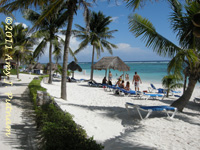 Time to hit the water! We left our empty building, and wow! We emerged onto a long, beautiful white sand beach, complete with lounge chairs, a small snorkel shop/hut, and people all over the place. Given how deserted the building seemed to be, I was not expecting this at all. It was like we had stepped right into the pages of one of those vacation brochures that shows the impeccable beaches, impossibly blue skies and warm, turquoise waters.
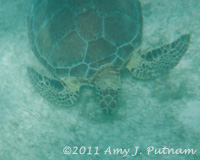
Jorge had explained to us that this is one of the few places in the world where sea turtles can be found all year. Protected by a barrier reef, turtles come into Akumal just about every day to eat sea grasses and jelly fish in the shallow bay. After donning our gear, we backed up into the water and away we went. It took me a few minutes to get past over-focusing on breathing through my mouth, and then having to swap masks with Jorge since I could not see anything (thanks again, Jorge!) and hey! Turtles! I was amazed at how quickly we started to find them, and how relatively close to the beach we always were. We spent about 45 minutes in the water, and all told saw probably 8-10 turtles, mostly adult females and also one younger turtle (smaller than the rest). Several turtles had remora fish on or under their shells also. One turtle wasn’t so keen on all of us water tourists so swam away, but the rest were pretty comfortable just ignoring us and going about their business. My most exciting moment came when one of the turtles came up for air and literally came within inches of touching me as she passed by. It doesn’t really work to try to back pedal with swimming fins, but I tried my best to stay out of her way, not thinking just to be still and give her enough credit for knowing full well how to avoid me. I was definitely caught up in the moment. Several times, Jorge went deeper into the water and waggled his fingers in front of some turtles and one southern stingray that we saw because that will sometimes prompt them to move around a little. They pretty much ignored him completely (and he was very careful never to make contact with them or harass them. If they didn’t react, he let them be.)
 Jorge then led us over to a small reef area, and tried to find a barracuda for us. No luck there, but I loved feeling like I was swimming through a National Geographic program, watching various fish in a wide array of colors swimming around. The water in the bay is relatively shallow, and the one anxious moment here was passing rather closely over a taller section of reef. I stopped kicking and just did a breaststroke to move past that point. The largest fish we saw was a puffer fish (un-puffed).
Too quickly, our time in the water was through. The couple from Ft. Lauderdale had their own gear so went back in the water for a while which made me a little envious. I should have checked the gear shack right on the beach, but I was feeling like I had been spendy enough for the day so wandered around instead. I was glad I had decided not only to splurge on the excursion but also to pay onboard ship premium prices for disposable waterproof cameras (it wasn’t enough that I was a gawky American tourist in Mexico, but I also had to be a gawky American tourist in the water, with two of those things dangling from my wrists). Wish I had listened to my friend, Susan, with whom I had dinner the night before the cruise in Ft. Lauderdale, when she offered to take me to Walgreen’s to get a couple of cameras. While the photos I got with them were far below Brian Skerry or Flip Nicklin caliber (get their new books, Ocean Soul and Among Giants, respectively. Seriously – AMAZING), I am glad I had something with me. Naturally, I am eager now to recreate the experience but with a better camera. Where’s that winning lottery ticket??
After a couple of hours relaxing on the beach, and lunch at a burger shack nearby, we climbed back into the van to head back to Playa del Carmen. Coming from New England where late fall was deeply in place and our world was increasingly brown and dreary, it was nice to see all of the lush vegetation, and also sobering to see the wide range of quality of living quarters we passed on the road. Poverty was easily evident, and I was reminded of just how very fortunate I was to have this experience at all. We also were able to catch a glimpse of activity in the eagle’s nest on the return trip. After getting drenched in rain in the short walk from the covered dock to the ferry, it was nice to sit and reflect on the day. Being a big music fan, having the right tunes with which to think helps a lot. I listened to Carrie Newcomer‘s “Everything is Everywhere” on that ferry ride, and it was the perfect soundtrack for my thoughts. We were dropped off “downtown” (as opposed to the ship’s pier from where we started). I made the valiant effort to walk back to the ship and got maybe 75% of the way back before my feet gave out and I finally hailed a cab (I had been walking for over an hour at that point). Along the way, I saw a crab on a waterside bench, probably washed there by waves crashing up against the sea wall. Tried to figure out a way to flick it back into the water, but it was having none of that, skittering away on the bench any time I got close. It was a little comical, really.
According to Jorge, we saw mostly loggerhead turtles, but possibly also one green turtle. I tried to see if I could glean the distinctions from my photos but I am just not accustomed to photo IDs of turtles at this point, especially from fair quality photos taken with disposable cameras. We also saw a southern sting ray and a skate I can’t quite identify. I am grateful to Jorge for being a funny, well informed and terrific guide/naturalist, my fellow snorkelers for good company, and the turtles themselves, for being so naturally awesome.
You can learn more about efforts to protect the bay and its marine visitors by visiting the website for Centro Ecológical Akumal (site is in English).
And feel free to check out the photos I did get, keeping in mind the ‘equipment’ I was using. Might not have been high end, but it was better than nothing!
Over the course of the whole cruise weekend, I saw pelicans, fish, crabs, a reef and turtles. This has lead to a strong desire to watch “Finding Nemo” again.
Duuuuuuuuuude. Turtles rock.

 by Tom Rose (formerly titled Freeing the Whales) so am curious to read the more detailed account. If anyone has any other reading to recommend from this event, please